
A 1966 Impala is a minor facelift of the 1965, while the 1967 was restyled with stronger “Coke bottle” curves on the same perimeter frame (1, 2). The quickest tells are at the ends: the ’66 has thin rectangular taillights and a grille with squared-off corners around the headlights, while the ’67 has trapezoidal three-segment taillights and a wider grille with lamps at each corner (1, 2). On the two-door Sport Coupe, the ’67 roof becomes a fastback that flows in an unbroken line into the rear deck (1).
’66 vs ’67 Impala at a glance
| Feature | 1966 Impala | 1967 Impala |
|---|---|---|
| Body | Minor facelift of the 1965 car (1) | Restyled with stronger “Coke bottle” curves and fender bulges (1, 2, 4); Sport Coupe gets a fastback roofline (1) |
| Frame | Perimeter frame introduced for 1965 (1) | Same perimeter frame (1) |
| Grille | Revised horizontal-bar grille with squared-off corners, enclosing the headlights (1, 2) | Wider grille with prominent lamps at each corner, above a larger bumper (2) |
| Taillights | Thin rectangles, three per side, wrapping around (1, 2, 3) | Trapezoidal, in three distinct segments (2) |
| Base engines | 250 six; 195-hp 283 V8 (1) | 155-hp 250 six; 195-hp 283 V8 (1) |
| Mid-range V8s | 275-hp 327; 325-hp 396 (1, 3) | 275-hp 327; 325-hp 396 (1, 4) |
| Top engine | 427 at 390 hp, or 425 hp in high-performance form (1, 3) | 385-hp 427; the 425-hp version was not offered (1, 4) |
| Impala SS | New “Strato-bucket” front seats and a center console (1) | Black grille and molding accents, “Impala SS” badges in place of “Chevrolet” and “Impala”, optional SS427 package (1, 4) |
| Impala SS production | About 117,000 (1) | 76,055, including 9,545 convertibles and 2,124 with the SS427 package (1, 4) |
| New safety equipment | — | Collapsible energy-absorbing steering column, dual master brake cylinder, side marker lights (1, 4) |
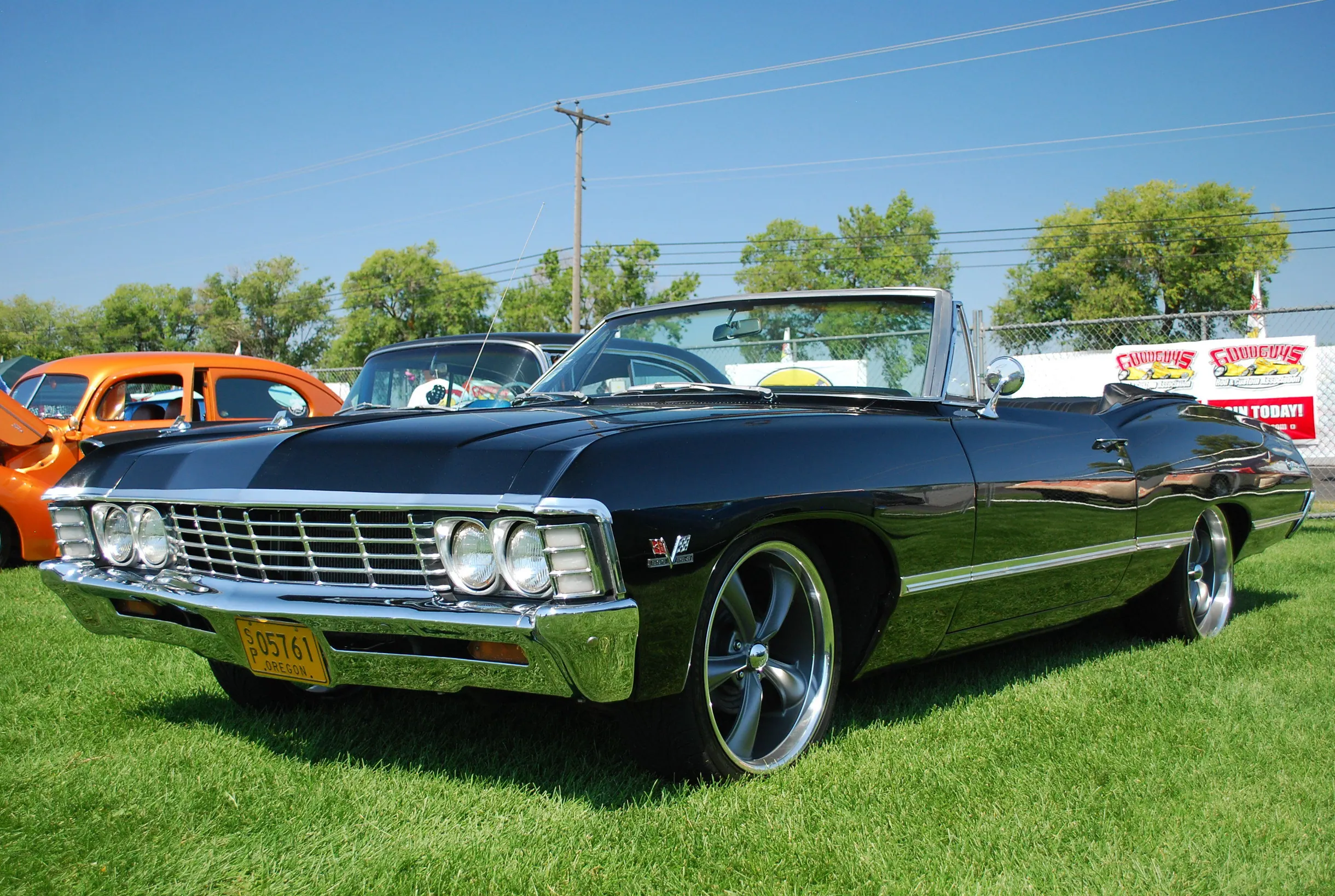
The photo
Questions people ask
What is the quickest way to tell a ’66 Impala from a ’67? Look at the taillights: thin rectangles on a ’66, trapezoids split into three segments on a ’67 (1, 2). From the front, the ’67 grille is wider, with lamps at each corner, and sits above a larger bumper (2).
Did the ’66 and ’67 Impala have the same engines? Mostly: both years offered the 250 six, the 195-hp 283, the 275-hp 327 and the 325-hp 396 (1, 3, 4). The difference is at the top, where 1966 offered 427s of 390 and 425 hp, and for 1967 the 385-hp 427 was the most powerful choice (1, 3, 4).
How did the Impala SS change from 1966 to 1967? The ’66 SS got new Strato-bucket front seats and a center console (1). The ’67 SS was trimmed more plainly, with black grille and molding accents and “Impala SS” badges, and gained the SS427 package (1, 4). SS production fell from about 117,000 in 1966 to 76,055 in 1967 (1).
Is a ’67 Impala built on a different frame than a ’66? No. The 1967 was restyled but kept the redesigned perimeter frame introduced on the 1965 models (1).
How does a ’65 Impala compare with a ’67? The 1965 introduced the perimeter frame the ’66 and ’67 kept; the ’66 was a minor facelift of the ’65, and the ’67 was restyled (1). For the year-to-year changes, see our ’65 vs ’66 Impala comparison.
Sources
- Chevrolet Impala (fourth generation) — Wikipedia
- 1965-1969 Impala & Full-Size Chevy Identification Guide — Classic Industries (parts supplier), no date shown
- 1966 Chevrolet Facts, Figures, and Specifications — Over-Drive Magazine, 26 Aug 2024
- 1967 Chevrolet Facts, Figures, and Specifications — Over-Drive Magazine, 20 Sep 2024; 76,055 SS = 66,510 Sport Coupes + 9,545 convertibles per this page; matches source 1's total.
1 Comment
Bill Carr
67 Impala